The biggest dates of Dahlonega’s fall 2026 season are set. Gold Rush Days, the town’s largest festival, returns October 17 and 18 around the Public Square. Leaf color in the North Georgia mountains typically peaks in late October, and the state’s official Leaf Watch tracking begins October 1. Old Fashioned Christmas opens November 27 with the Lighting of the Square. Here is what is verified so far.
Fall in Dahlonega fills the calendar again this year: the 72nd Gold Rush Days festival on October 17 and 18, mountain leaf season through late October, and Old Fashioned Christmas beginning November 27. This roundup tracks the dates that are confirmed and flags the ones still to come.
Dahlonega fall events 2026: how this roundup works
Fall in Dahlonega compresses a lot of living into about ten weeks. The season has three anchors, and each one is confirmed on official sources as of September 27, 2026: the Gold Rush Days festival on October 17 and 18, leaf color that typically builds through late October, and Old Fashioned Christmas, which starts the day after Thanksgiving and runs into January.
Every date below was checked against the organizer or agency that owns it: the festival committee’s own site, the Dahlonega-Lumpkin County Visitors Bureau, the Christmas event committee, the Georgia Forestry Commission, Georgia State Parks, and the U.S. Forest Service. Where something is not yet published, we say that plainly rather than guessing. A roundup like this is only useful if you can plan on it. For dates at a glance, the Journal’s events calendar keeps the quick listing; this guide adds the context and planning detail.
| Event | 2026 dates | Status |
|---|---|---|
| Gold Rush Days festival | Saturday and Sunday, October 17 and 18 | Confirmed by the organizer and the visitors bureau |
| Peak leaf color in the mountains | Typically late October | No 2026 forecast yet; state tracking opens October 1 |
| Old Fashioned Christmas | November 27 through January 7, 2027 | Confirmed by the official event site |
Gold Rush Days 2026: October 17 and 18 around the Public Square
The 72nd Annual Gold Rush Days Festival is set for Saturday and Sunday, October 17 and 18, 2026. That fits the festival’s fixed pattern: it is always held the third full weekend in October, and it lands in the Historic District, with vendors gathered around the Public Square.
The Visitors Bureau describes it as Dahlonega’s largest festival of the year, and says it draws thousands of visitors. On vendor count the official sources disagree with each other: the bureau says more than 300 art and craft exhibitors and food vendors, while the festival’s own info page says more than 200. Either way, plan for several hundred booths and a square that is fully occupied.
Festival hours run 9:00 a.m. to 5:30 p.m. both days, per the organizer’s vendor page. Times can vary between listings; confirm on the official organizer pages before you go. The Saturday schedule, as printed on the official 2026 schedule, runs from the Gold Rush 5K at 8:00 a.m. (put on by the Dahlonega Rotary Club), through the 9:00 a.m. opening, to the Gold Rush Parade at 3:00 p.m. and a 4:30 p.m. concert. Sunday opens at 9:00 a.m., with the arm wrestling tournament among the afternoon events at 3:00 p.m.
The parade is confirmed as a 2026-specific detail on the organizer’s application page: it steps off at 3:00 p.m. Saturday, October 17, rain or shine. Units line up by 2:00 p.m. in front of the Dahlonega Police Department, with floats entering the lineup area from the north side of Highway 60, and the route ends in the University of North Georgia Drill Field Circle. If you want to march in it rather than watch, online applications close October 14 by the application page’s date, though the homepage banner says October 15, so the earlier date is the safe one.
One thing no official page states: what admission costs, if anything. The visitors bureau page, the organizer’s homepage, and the vendor and parade pages are all silent on it. Check goldrushdaysfestival.com before you go, and treat anything else you read as unconfirmed.
Beyond the parade, the bureau’s description of the festival includes live music, gold panning, children’s activities, and traditional Appalachian demonstrations. The festival honors the gold rush that built the town, and the whole weekend is run by the Gold Rush Days Festival committee, which says 100 percent of proceeds go back to the community: scholarships for seniors at Lumpkin County High School and Mountain Education Charter High School, the Empty Stocking Christmas project, and direct local support.
Streets, parking, and the Gold Museum on festival weekend
The organizer’s recurring weekend pattern works like this: vendor registration runs Friday afternoon and evening, streets around the festival close to the public at 6:00 p.m. Friday (tents cannot go up before then), booths are set and vehicles out by 7:30 a.m. Saturday and 8:00 a.m. Sunday, and streets re-open to the general public at 8:00 p.m. Sunday. In practice, treat the square as a walk-only zone for the whole weekend.
We could not check road closures against the City of Dahlonega’s own site, because the city’s web presence would not resolve when we checked on September 27, and the county homepage carries no festival detail. Closure and detour specifics come from the festival committee, so we point you to the organizer for those rather than paraphrasing a city page we cannot verify exists right now.
If you want a quiet hour away from the booths, the Dahlonega Gold Museum State Historic Site sits right at 1 Public Square, on the festival grounds. It keeps its own hours (Monday through Saturday 9:00 a.m. to 4:45 p.m., Sunday 10:00 a.m. to 4:45 p.m.) and its own admission, separate from anything the festival charges. The state parks page makes no mention of Gold Rush Days programming, so we will not invent any: go for the museum itself.
Leaf season 2026: no forecast yet, and the clock starts October 1
No official 2026 fall color prediction exists yet. The Georgia Forestry Commission says its Leaf Watch begins October 1, and its 2026 tracking map was published September 2. Until the reports start, anyone naming a specific peak weekend for this year is guessing, and we will not join them.
What official sources do give you is the mechanics of how color moves. The U.S. Forest Service describes fall color cascading down the mountains from the highest peaks into the valleys, dropping roughly 1,000 feet in elevation every week. The same agency notes that a drier summer tends to produce more intense reds, cool September mornings help color develop, and a clear, dry, cool October keeps it on the trees longer.
For timing, the state’s tourism office puts it plainly: Georgia’s mountain parks typically peak in late October, though color can appear as early as September and last through much of November. The Forestry Commission’s own recent-season reports fit that pattern. In 2024, its October 16 report put the strongest color above 3,500 feet, with the highest elevations at their best for the final weekend of October and elevations under 3,000 feet holding strong through the first week of November. In 2025, the commission tracked Northwest Georgia to peak in the first week of November.
No official source publishes a Dahlonega-specific peak date, so treat late October as the planning anchor and check the Leaf Watch reports once they start. A few practical notes for the season: Vogel State Park, at 2,500 feet at the base of Blood Mountain, warns that a new visitor center is under construction and parking may be very limited this season. The Forestry Commission also reminds leaf-peepers that it can be clear and sunny down in the piedmont while fog and drizzle sit on the high elevations. For a look before you drive, the Forest Service runs live webcams from Brasstown Bald, at 4,784 feet the highest point in Georgia.
The Journal keeps a fuller treatment of the season, including the scenic drives around the county, in our fall color guide to the North Georgia mountains.
The Christmas lead-in: Old Fashioned Christmas starts November 27
Dahlonega swings straight from fall into Christmas. Old Fashioned Christmas 2026 runs November 27, 2026 through January 7, 2027, per the official event site‘s calendar.
The Lighting of the Square and Tree is set for 6:00 p.m. that Friday, November 27, with Santa outside the Visitor Center and road closures in the area from 3:00 to 8:00 p.m. that evening. Visit Santa runs November 27 through December 29, with free photos on the square. The Historic District’s lights stay on dusk to 11:00 p.m. through January 7.
Two calendar items follow. The Christmas Parade is set for Saturday, December 12, starting at the Holly Theater, running east on Main Street to Old Courthouse Hill, and returning to the theater, rain or shine. Its start time was not yet posted when we checked. And horse-drawn carriage rides from Dahlonega Carriage and Horse Rides are expected to begin Black Friday evening per the Visitors Bureau, running 4:00 to 9:00 p.m. weather permitting, cash only at 20 dollars per adult and 10 dollars for children under 12, boarding at the corner of North Chestatee Street and West Main Street, first come, first served. The dated nightly schedule for 2026 has not been published yet.
The Visitors Bureau points to why the town leans into this: Travel Channel named Dahlonega one of the best small towns to visit at Christmas, and Reservations.com listed it among its Top 25 Hallmark Christmas Towns. The downtown authority says the storefronts around the square, 65 of them, keep extended shopping hours from the Friday after Thanksgiving through the new year.
What is still to be announced, and where to check
Roundups age, and we would rather flag the gaps than paper over them. As of September 27, 2026, these items have no published 2026 detail: Gold Rush Days admission; the parade’s theme and entry fee; a full text version of the parade route beyond its staging and endpoint; the Christmas Parade start time; the 2026 date for the Live Nativity at Dahlonega Methodist Church (last held December 13, 2025); the nightly carriage schedule; and any Gold Museum programming tied to festival weekend.
The places that will publish them first: goldrushdaysfestival.com for the festival, dahlonegachristmas.com for the Christmas season, the visitors bureau events calendar for the tourism view, and the Leaf Watch pages named above. We will update this roundup as those dates land.
Planning a weekend around any of these dates? Our 48-hour Dahlonega itinerary holds up in any season. And if this is your first fall in town, the new-resident guide is a good next stop.
Sources: goldrushdaysfestival.com (festival info, vendor, and parade pages plus the official 2026 schedule), the Dahlonega-Lumpkin County Visitors Bureau (dahlonega.org), dahlonegachristmas.com and the Christmas in Dahlonega committee, the Dahlonega Downtown Development Authority, the Georgia Forestry Commission (gatrees.org), Georgia State Parks, and the U.S. Forest Service. Items were reviewed September 27, 2026.
Frequently Asked Questions
When is Gold Rush Days 2026 in Dahlonega?
Saturday and Sunday, October 17 and 18, 2026. The festival always lands on the third full weekend in October, and the 2026 edition is the 72nd annual, per the official schedule.
What time does Gold Rush Days open and close?
9:00 a.m. to 5:30 p.m. both days, per the organizer’s vendor page. Day-of details are worth confirming at goldrushdaysfestival.com.
How much does Gold Rush Days cost to attend?
No official source we reviewed publishes a 2026 admission price. Check the organizer’s site before you go; the Gold Museum on the square charges its own separate admission.
What time is the Gold Rush Days parade?
3:00 p.m. on Saturday, October 17, rain or shine. Units line up by 2:00 p.m. in front of the Dahlonega Police Department, and the route ends in the University of North Georgia Drill Field Circle.
When do the leaves change in Dahlonega?
Typically in late October in the North Georgia mountains. No official 2026 forecast exists yet; the Georgia Forestry Commission’s Leaf Watch begins October 1, and color drops roughly 1,000 feet in elevation per week from the high peaks down.
Where can I track 2026 fall color officially?
The Georgia Forestry Commission’s Leaf Watch (starting October 1), Georgia State Parks’ LeafWatch page, and the U.S. Forest Service. The smokymountains.com prediction map that circulates each fall is a third-party tool, not an official forecast.
When does Dahlonega’s Christmas season start in 2026?
Friday, November 27, 2026, with the Lighting of the Square and Tree at 6:00 p.m. and Santa outside the Visitor Center. The season runs through January 7, 2027.
When is the Dahlonega Christmas Parade?
Saturday, December 12, 2026. It starts at the Holly Theater, runs east on Main Street to Old Courthouse Hill, and returns. The start time had not been posted as of September 27.
Are the horse-drawn carriage rides running for Christmas 2026?
They are expected from Black Friday, November 27, per the Visitors Bureau, running 4:00 to 9:00 p.m. weather permitting. Cash only: 20 dollars per adult, 10 dollars for children under 12, infants free, boarding at North Chestatee Street and West Main Street.
Who organizes Gold Rush Days, and where does the money go?
The Gold Rush Days Festival committee, reachable through goldrushdaysfestival.com. The organizer states that 100 percent of proceeds return to the community, funding scholarships for Lumpkin County High School and Mountain Education Charter High School seniors and the Empty Stocking Christmas project.
Is Gold Rush Days good for kids?
The Visitors Bureau’s description includes children’s activities, gold panning, and traditional Appalachian demonstrations, alongside the parade and live music. There is also the Saturday morning 5K and an arm wrestling tournament on Sunday afternoon.
When was Dahlonega’s gold rush?
The gold rush dates to the late 1820s, and the official sources themselves split: the Visitors Bureau cites America’s first major gold rush in 1828, while the festival’s 2026 schedule graphic reads “America’s First Gold Rush 1829.” The Journal’s history of the gold that built the town takes the story from there.
Festival weekends have a way of turning visitors into residents. If the season has you thinking about buying or selling around Dahlonega, View new Dahlonega listings at Gold Peach Realty, or call (770) 283-1223 to talk with a local agent about your timeline.
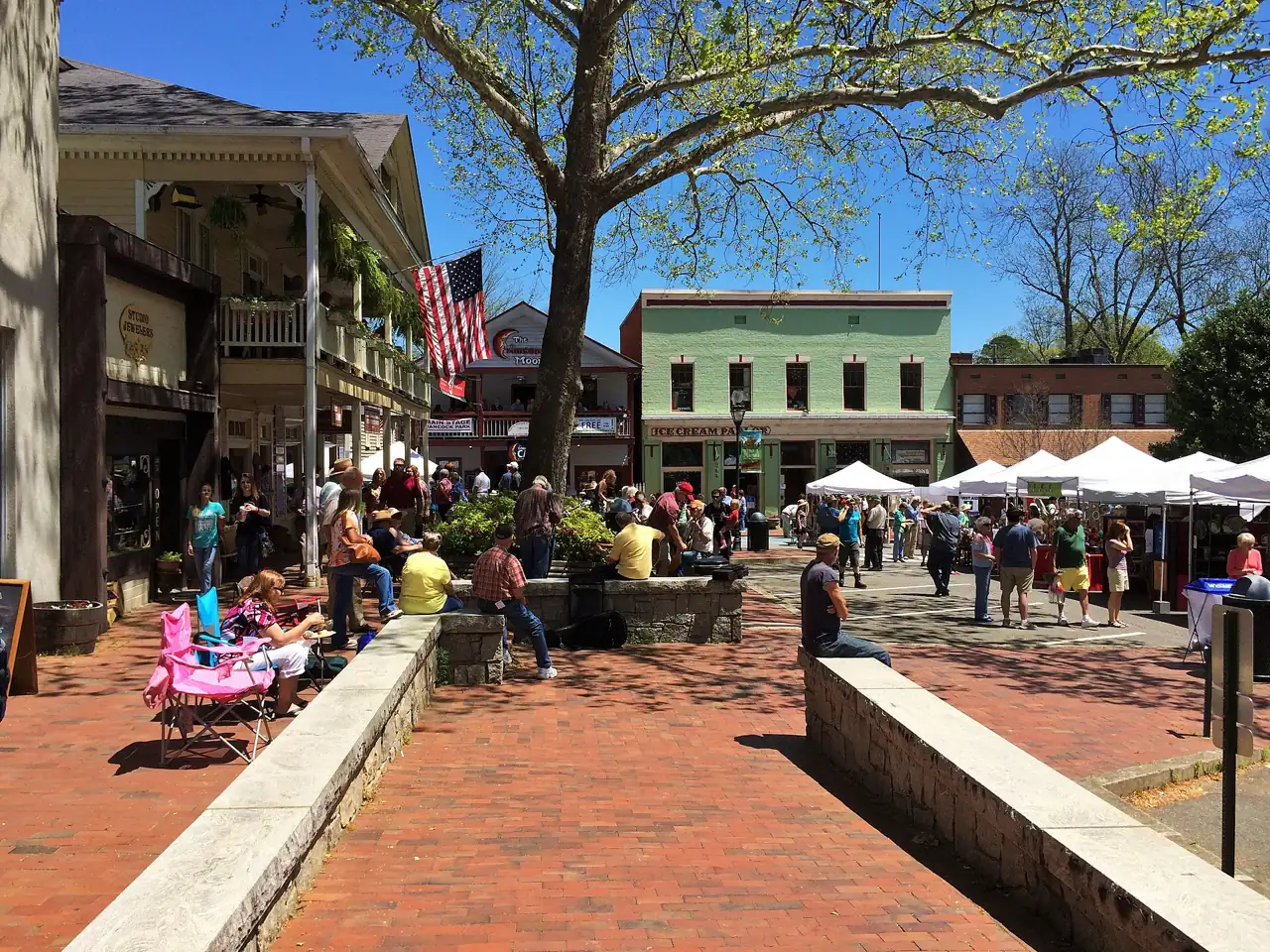
Photo credits: Dahlonega public square — Gwringle, CC BY-SA 3.0, via Wikimedia Commons.