The Gold That Built a Town: Dahlonega’s Rush of 1828
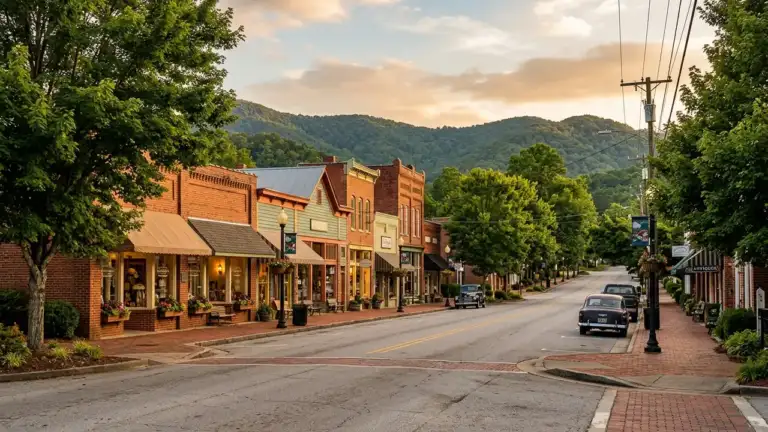
Long before California captured the world’s imagination with its gold fever of 1849, a quiet stretch of the North Georgia mountains ignited the first major gold rush in United States history. What began in 1828 as a singular discovery along a creek bank transformed the Cherokee homeland, shaped the American frontier, and gave rise to the city of Dahlonega—a name derived from the Cherokee word talonega, meaning “yellow money” or “precious yellow.”

The Discovery That Changed Everything
The precise origins of the Georgia Gold Rush remain a subject of some historical debate, but the most widely accepted account credits Benjamin Parks, a deer hunter from Habersham County, with the pivotal find. In the autumn of 1828, Parks was hunting near Ward’s Creek in what is now Lumpkin County when he kicked over a stone and noticed a glittering metalite material beneath it. The substance was gold—placer gold, worn smooth by centuries of stream action—and its discovery set off a chain of events that would reverberate across the young nation.
Word spread with remarkable speed for an era before telegraphs or railroads reached these mountains. Within months, prospectors from across Georgia and the Carolinas flooded into the region. By 1829, estimates placed the number of miners working the North Georgia hills at more than ten thousand. The camps that sprang up overnight were rough, transient places—collections of tents and crude cabins arranged along creek banks wherever color, as the prospectors called visible gold, had been found.
The land these men poured onto was not empty. It was the sovereign territory of the Cherokee Nation, a people who had lived in the southern Appalachians for centuries and who had, by the 1820s, built a sophisticated society with a written language, a constitutional government, newspapers, and farms. The intrusion of thousands of fortune-seekers represented not merely an inconvenience but an existential crisis for the Cherokee people.
The Branch Mint at Dahlonega
As the scale of the Georgia gold find became clear to the federal government, Congress moved to bring order to what had become a chaotic extraction industry. In 1835, legislation authorized the construction of branch mints at Dahlonega, Georgia and Charlotte, North Carolina—the two centers of Southern gold production—as well as New Orleans, which would process coinage for the Gulf Coast’s expanding commerce.
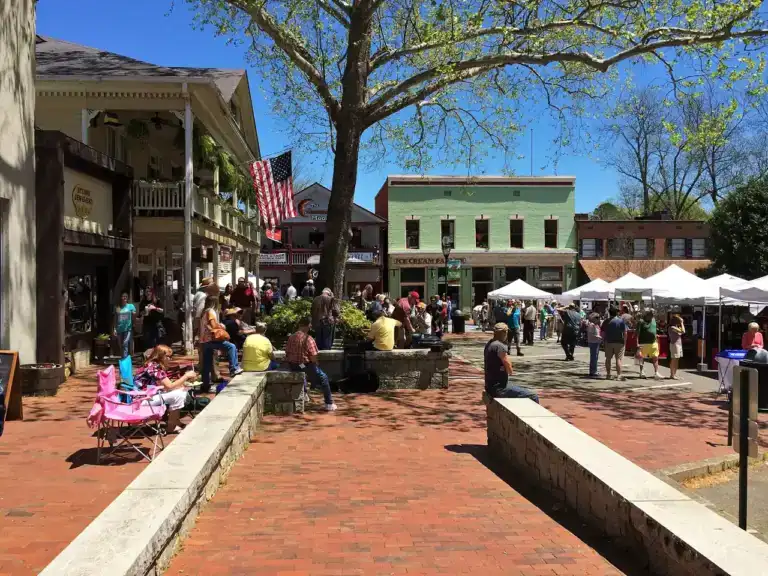
The Dahlonega Branch Mint opened in 1838 and quickly became the economic and civic anchor of the new town that had been platted around it. The mint building, an imposing structure of dressed stone, stood at the center of the public square and processed millions of dollars in gold coinage before it suspended operations in 1861 at the outbreak of the Civil War. In its twenty-three years of operation, the Dahlonega Mint produced approximately 1.4 million gold coins with a face value of more than six million dollars.
The mint’s coins bore a distinctive “D” mintmark, the same letter designation used today by the Denver Mint—though the two facilities are entirely unrelated. Dahlonega Mint coins are today prized by numismatists for their historical significance and relative scarcity. Examples in good condition command substantial premiums at auction, particularly the quarter eagles and half eagles struck in the mint’s early years of operation.
When Georgia seceded from the Union in January 1861, the state seized the mint building and its remaining gold reserves. The facility briefly operated under Confederate authority before being converted to a storehouse. The original building was destroyed by fire in 1878. Price Memorial Hall, the landmark gold-domed building now standing on the campus of the University of North Georgia, was constructed on its foundation in 1879 and remains the most visible legacy of the mint era in the modern town.
Cherokee Removal and the Trail of Tears
The gold rush accelerated a political and humanitarian catastrophe that was already gathering force before Parks’s discovery. The state of Georgia had long coveted Cherokee lands, and the gold find provided both additional economic motive and popular pressure to force the issue. In 1830, President Andrew Jackson signed the Indian Removal Act, authorizing the forcible relocation of the Five Civilized Tribes—Cherokee, Chickasaw, Choctaw, Creek, and Seminole—to territory west of the Mississippi River.
The Cherokee Nation resisted through every legal means available, appealing to the Supreme Court in Worcester v. Georgia (1832). Chief Justice John Marshall sided with the Cherokee in a landmark ruling, declaring that Georgia’s laws had no force within Cherokee territory. President Jackson, according to a remark attributed to him though disputed by historians, reportedly dismissed the ruling: “John Marshall has made his decision; now let him enforce it.” The federal government moved forward with removal regardless.
Between 1838 and 1839, approximately sixteen thousand Cherokee were forcibly marched westward to present-day Oklahoma under military escort. The journey, conducted largely in winter, killed an estimated four thousand men, women, and children from exposure, disease, and starvation. The Cherokee called it Nunna daul Tsuny—”The Trail Where They Cried.” History records it as the Trail of Tears, one of the darkest chapters in American history and a permanent moral stain on the era of the Georgia Gold Rush.
The Mechanics of Gold Mining in North Georgia
The gold of Lumpkin County and its neighboring counties occurred in two principal forms: placer deposits in stream beds and alluvial gravels, and lode gold embedded in quartz veins that ran through the crystalline basement rock of the Blue Ridge. Each type demanded different extraction techniques, and the evolution of mining methods in North Georgia over the nineteenth century tracks closely with the technological progress of the broader American mining industry.
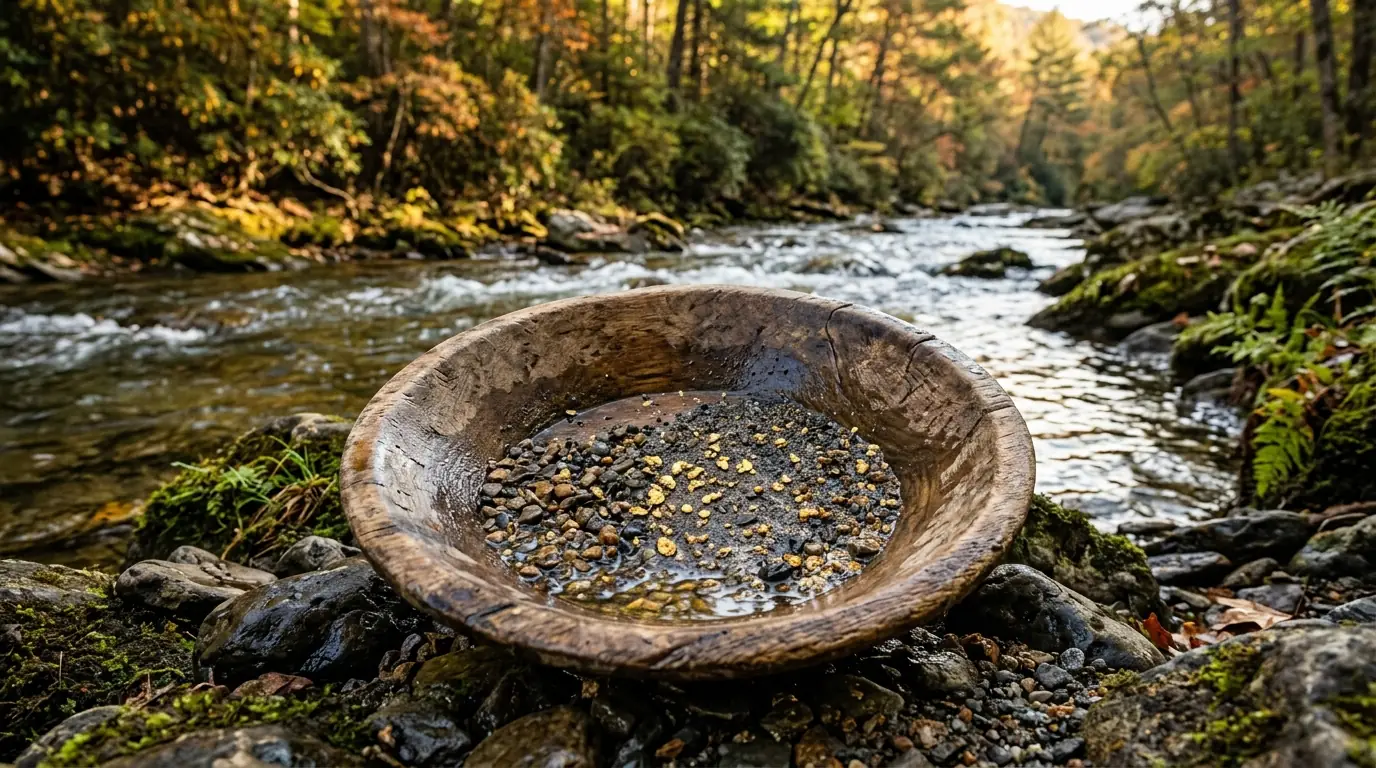
Placer mining, the simplest and earliest technique, required only a pan, a creek, and patience. Miners would fill a pan with stream gravel, submerge it in water, and agitate it in a swirling motion. Gold, being far denser than quartz sand or clay, would settle to the bottom while lighter material was washed over the pan’s rim. Skilled panners could process several cubic yards of material in a day, but the work was physically punishing and the returns for individual prospectors diminished quickly as the richest stream deposits were worked out.
More sophisticated placer operations employed the sluice box—a long, inclined wooden channel with riffles, or crosswise bars, on its floor. Workers would shovel gold-bearing gravel into the upper end of the sluice while water flowed through, washing away lighter material and trapping gold and heavy black sand behind the riffles. Hydraulic mining, which used pressurized water jets to break down entire hillsides, came later and caused significant environmental damage to many North Georgia stream systems.
Lode mining, which extracted gold from its original quartz matrix, was capital-intensive and required hard-rock tunneling, blasting, and stamp mills to crush the ore. The Consolidated Gold Mine, which opened in the 1880s on a major lode system two miles east of the Dahlonega square, represents the pinnacle of industrial-scale gold extraction in the region. Its workings extended more than two hundred feet below the surface and connected hundreds of individual tunnel sections. The mine today offers guided tours of its underground galleries and remains one of the most significant industrial archaeology sites in the Southeast.
The Assay Office and “There’s Gold in Them Thar Hills”
One of the most famous phrases in American popular culture has its origins, at least in popular legend, in Dahlonega. The saying “There’s gold in them thar hills” is traditionally attributed to a speech delivered by Dr. Matthew Stephenson, the Dahlonega Mint’s assayer, in 1849. As news of the California gold strike reached North Georgia and local miners began abandoning their claims to head west, Stephenson reportedly urged them to stay, pointing to the surrounding mountains as proof that Georgia’s gold resources were far from exhausted.
Whether Stephenson used those precise words is uncertain—the exact phrasing as popularly known appears to be a later popularization—but the sentiment he expressed was real: Georgia gold production continued for decades after 1849, and many of the miners who remained found the decision profitable. The phrase entered American idiom through newspaper reprints, theatrical productions, and eventually films, becoming shorthand for any situation where valuable resources remain untapped in familiar surroundings.
Gold in Dahlonega Today
While commercial gold mining in Lumpkin County effectively ended in the early twentieth century, the gold has never truly gone away. The same geological formations that drew tens of thousands of prospectors in the 1830s continue to yield the metal to patient searchers today. Recreational gold panning remains a popular activity at several locations in and around Dahlonega.
Crisson Gold Mine, operating on Wimpy Mill Road since 1969, offers visitors the chance to pan for gold in a working mine setting. The operation maintains several sluice boxes stocked with ore from its own tailings, providing a reliable gold-finding experience for families and visitors of all ages. The mine also features a stamp mill, cyanide vats, and other artifacts of historical gold processing operations.
The Consolidated Gold Mine offers a more industrially oriented experience, with guided underground tours led by knowledgeable staff who explain the geology, history, and mechanics of hard-rock gold mining. After the tour, visitors can pan for gold in the mining operation’s outdoor panning area, using stream-fed sluice boxes supplied with ore concentrate.
The Dahlonega Gold Museum Historic Site, operated by the Georgia Department of Natural Resources on the north side of the public square, houses the most complete collection of Gold Rush-era artifacts and documentary materials in the region. The museum occupies the former Lumpkin County courthouse, built in 1836, and its exhibits trace the full arc of the Georgia Gold Rush from initial discovery through the Cherokee removal, the mint era, and the shift to industrial mining. A short film shown in the building’s main hall provides essential historical context for visitors new to the subject.