A Hiker’s Guide to Blood Mountain and the Georgia Appalachian Trail

At 4,458 feet above sea level, Blood Mountain stands as the highest peak on the Appalachian Trail in Georgia and one of the most storied summits in the entire 2,190-mile footpath. Located within the Chattahoochee National Forest approximately twelve miles southeast of Dahlonega, it draws tens of thousands of hikers annually—from casual day-trippers seeking panoramic views to thru-hikers marking their first major milestone on the journey to Maine. This guide covers the mountain’s history, geology, access points, trail conditions, and practical advice for making the most of a visit.
The Mountain’s Name and History

Blood Mountain’s vivid name has inspired considerable speculation over the years. The most widely repeated origin story holds that a brutal battle between the Cherokee and the Creek nations was fought on or near its slopes, staining the mountain’s rocks red with the blood of the fallen warriors. While intertribal warfare between the Cherokee and the Muscogee (Creek) people did occur in the region, historical and archaeological evidence for a specific decisive engagement at this site is limited.

A more prosaic but equally plausible explanation ties the name to the mountain’s characteristic red lichens—Cladonia cristatella and related species—that coat the summit rocks and give them a reddish cast, particularly when wet. The Cherokee themselves called the mountain Slaughter Mountain in some accounts, which may reflect either the battle legend or simply the challenging character of the ascent.

The mountain falls within the Blood Mountain Wilderness, a federally designated wilderness area of approximately 7,800 acres established in 1991. Wilderness designation prohibits mechanized equipment, motorized vehicles, and commercial activities within the area’s boundaries, preserving the remote character of the surrounding terrain even as the mountain itself receives heavy visitor use.

Geology of the Summit

Blood Mountain’s bedrock is among the oldest exposed rock in the eastern United States. The summit is capped by Blood Mountain Biotite Gneiss, a metamorphic rock formed roughly one billion years ago during the Grenville orogeny—the ancient mountain-building event that created the Precambrian basement of the Appalachians. Subsequent tectonic events, including the Taconic and Acadian orogenies of the Paleozoic era and the final assembly of the Appalachian chain during the Alleghanian orogeny approximately 300 million years ago, folded, faulted, and metamorphosed the original sedimentary and volcanic rocks into the crystalline gneisses and schists visible today.

The open, rocky summit—a relatively rare feature in the heavily forested southern Appalachians—results from the combination of thin, nutrient-poor soils, exposure to desiccating winds, and the slow growth rates of trees at higher elevations. The summit vegetation community is classified as a Southern Appalachian Rocky Summit, a globally rare ecosystem type that supports an assemblage of plants found only in similar high-elevation rock outcrops throughout the southern mountains.

The Primary Routes to the Summit

TRAIL · MOST POPULAR ROUTE

Appalachian Trail from Neels Gap (Byron Herbert Reece Trail Junction)

The most heavily traveled approach to Blood Mountain begins at Neels Gap (elevation 3,125 feet) on U.S. Highway 19/129, where the Appalachian Trail passes directly through the Mountain Crossings outfitter and hostel—the only place in the world where the AT passes through a building. From the gap, the AT ascends steadily northward through a forest of yellow birch, American beech, and Fraser magnolia, gaining approximately 1,300 feet over 2.2 miles to the summit. The round-trip distance from Neels Gap is 4.4 miles with an elevation gain of about 1,400 feet.

The trail is well-blazed with the AT’s white paint blazes and generally easy to follow, though sections of the upper trail involve scrambling over exposed rock faces that can be slick when wet. Parking at Neels Gap is limited; an overflow lot is located a short distance south on Highway 129. Trail use fees may apply; check current Georgia Appalachian Trail Club guidance before visiting.

Trailhead: Neels Gap, U.S. 19/129, Blairsville, GA 30512 (Lumpkin/Union County line) | Distance to Summit: 2.2 miles one way | Elevation Gain: 1,340 feet

TRAIL · LONGER LOOP OPTION

Freeman Trail Loop via Slaughter Creek Trail

Hikers seeking a more substantial outing can access Blood Mountain from the Byron Herbert Reece trailhead on Highway 19, approximately three miles south of Neels Gap. From here, the Freeman Trail ascends to join the AT, which continues to the summit, and the return can be made via the Slaughter Creek Trail and Byron Herbert Reece Trail for a loop of approximately six miles with an elevation gain of roughly 1,700 feet. This route passes through more varied forest types and offers a less crowded experience than the direct Neels Gap approach.

Trailhead: Byron Herbert Reece Trailhead, U.S. 19, Blairsville, GA | Distance: 6 miles loop | Elevation Gain: approximately 1,700 feet | Fee: daily parking fee required

The Blood Mountain Shelter

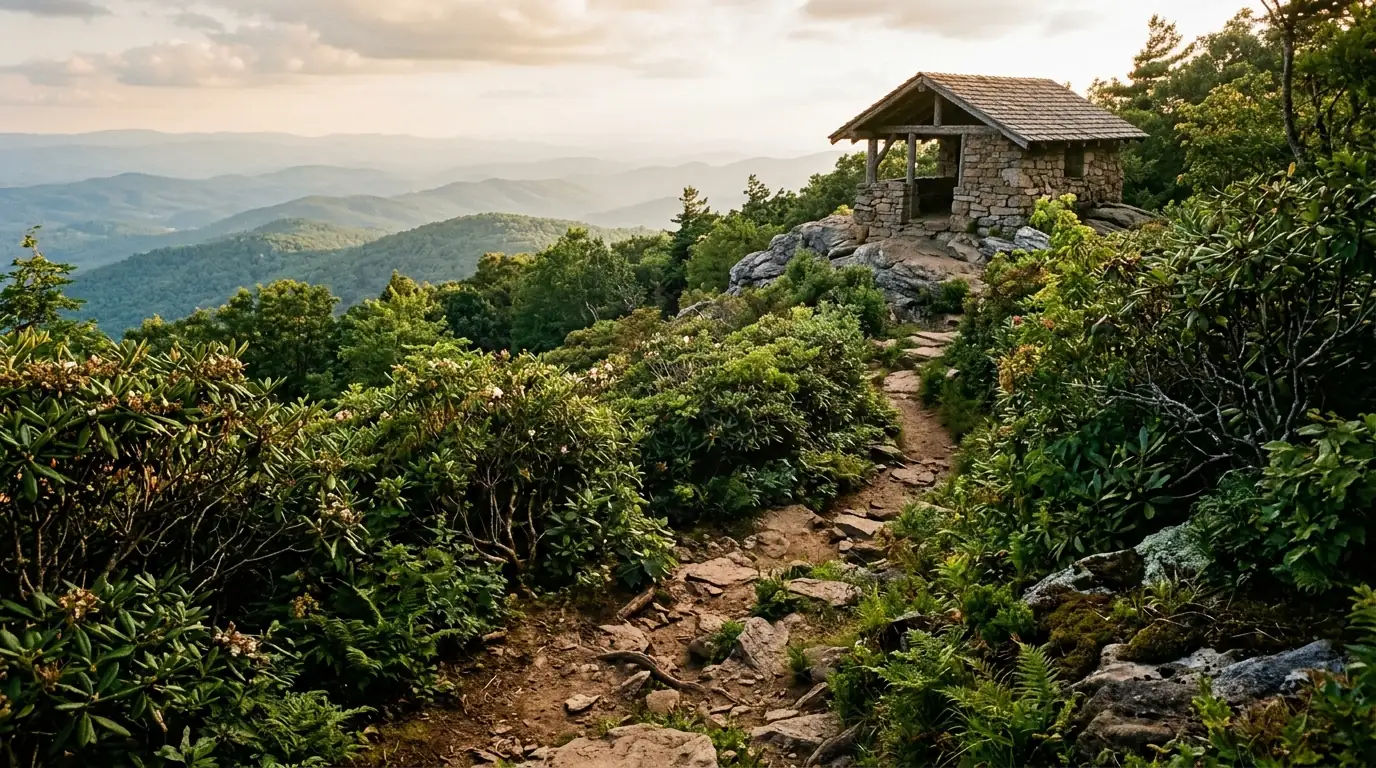
The summit area of Blood Mountain is dominated by the historic Blood Mountain Shelter, a stone structure built by the Civilian Conservation Corps in the 1930s. The shelter consists of two stone rooms with a fireplace—an unusual feature among AT shelters—and can accommodate approximately eight to twelve hikers in its sleeping loft. The structure is one of the few remaining CCC-built shelters on the entire Appalachian Trail and has been designated a historic landmark.

Like all AT shelters, the Blood Mountain Shelter operates on a first-come, first-served basis for overnight users. Backpackers planning to camp at or near the summit should be aware that camping within the Blood Mountain Wilderness is restricted to designated sites; dispersed camping is prohibited within a quarter-mile of the trail. Water sources near the summit are limited; the closest reliable water is at Slaughter Creek, approximately 0.8 miles south of the summit on the AT.

Views and Natural Features

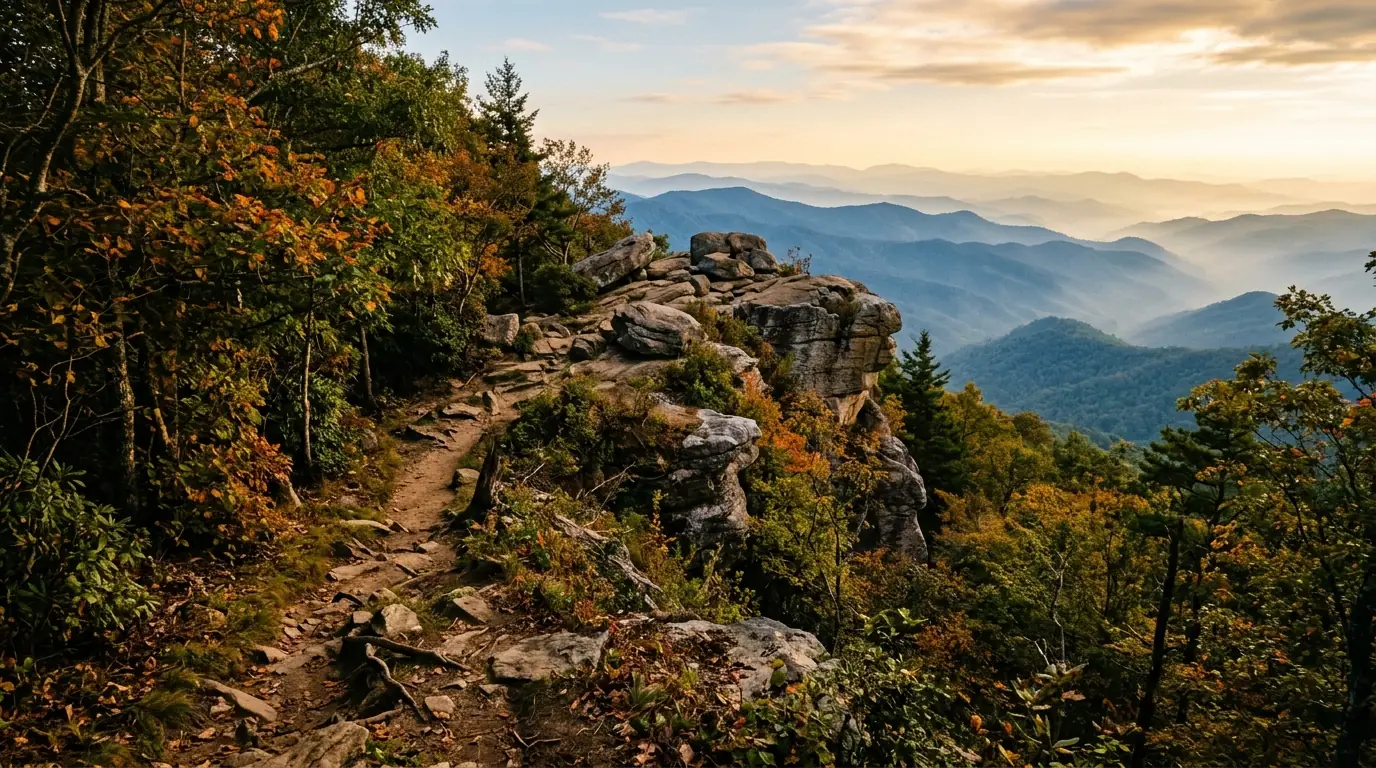
On clear days, the summit of Blood Mountain offers views in multiple directions across the Blue Ridge. To the north and west, the ridgeline of the southern Appalachians recedes toward the Smokies. To the south and east, the piedmont of Georgia is visible in the middle distance, and on exceptionally clear autumn days, observers have reported seeing the Atlanta skyline more than sixty miles away. The summit’s exposed rocks and scattered clumps of mountain laurel and Catawba rhododendron are particularly striking in late May and early June when the rhododendrons are in full bloom.

The transition zone between the oak-hickory forests of the lower elevations and the northern hardwood forests of the higher ridges is ecologically significant. Hikers ascending Blood Mountain pass through several distinct vegetation communities compressed into a vertical span of about 1,300 feet—a compressed version of the latitudinal plant communities that stretch from Georgia to Canada. Species of particular interest include the Fraser magnolia (Magnolia fraseri), yellow buckeye (Aesculus flava), and the endemic Oconee bells (Shortia galacifolia), found only in a narrow band of the southern Appalachians.

Practical Information for Visitors

Blood Mountain is accessible year-round, but conditions vary dramatically by season. Summer weekends bring the largest crowds and the highest heat and humidity; starting early—on the trail by 7 a.m.—avoids both the worst of the heat and the parking difficulties that can develop by mid-morning. Autumn, particularly October, offers ideal hiking conditions and the additional spectacle of the fall color display; expect company on the trail and plan parking accordingly.

Winter hiking on Blood Mountain is feasible and rewarding, with the leafless canopy opening long views through the forest and the absence of crowds making the experience considerably more contemplative than summer visits. Ice and snow can make the upper trail, particularly the rocky sections below the summit, genuinely hazardous; micro-crampons or trail crampons are strongly recommended for winter visits when temperatures have been below freezing. Spring brings wildflowers and occasional beautiful weather but also the highest rainfall totals and the muddiest trail conditions of the year.

The nearest trailhead services are at Mountain Crossings at Neels Gap (shoes, gear, gear shakedowns for thru-hikers, limited groceries, overnight accommodations). The closest full-service town is Dahlonega, approximately twelve miles north on U.S. 19, where lodging, restaurants, and outdoor outfitters are plentiful. Cell phone coverage is unreliable on the mountain; download offline maps before departing and carry a paper map of the area as backup.

Mountain Crossings at Neels Gap: 13 Mountain Crossings, Blairsville, GA 30512 | Phone: (706) 745-6095 | Open daily

Other Notable Trails Near Dahlonega

TRAIL · WATERFALL DESTINATION

Amicalola Falls State Park Approach Trail

Located approximately fifteen miles west of Dahlonega, Amicalola Falls is the highest cascading waterfall east of the Mississippi River, dropping 729 feet in a series of tiered cascades. The falls are accessible via a short but steep approach trail of 0.4 miles from the lower parking area, or via a longer 4.4-mile approach that connects to the AT’s southern terminus at Springer Mountain. Amicalola Falls State Park is the official approach trailhead for southbound AT thru-hike orientation and thru-hiker registration.

280 Amicalola Falls State Park Road, Dawsonville, GA 30534 | Phone: (706) 265-4703 | Park pass or daily parking fee required

TRAIL · LOCAL FAVORITE

Yahoola Creek Reservoir Trail

The Yahoola Creek Reservoir, located just north of Dahlonega, offers a gentle 3.5-mile loop trail around the reservoir shoreline that is popular with local residents seeking a lower-elevation alternative to the mountain trails. The trail passes through mixed pine-hardwood forest and offers views across the water to the surrounding ridges. The reservoir itself, completed in 1957, serves as Dahlonega’s primary municipal water supply; the surrounding buffer land is maintained as a natural area by the city.

TRAIL · RIVER CORRIDOR

Chestatee River Greenway

The Chestatee River, which flows through Lumpkin County and played a central role in the Gold Rush era as the source of much of the region’s placer gold, is today a designated Georgia Scenic River and a popular recreational corridor. The upper Chestatee offers Class I and Class II whitewater suitable for canoes, kayaks, and inner tubes, and the riverbanks provide some of the most accessible flat-water paddling in North Georgia for beginners. Guided float trips depart from Dahlonega’s outfitter services and typically run two to four hours depending on the chosen section.